Journal ·
First Brew
A first attempt with the siphon: slow drawdown, a changing cup, and the search for coffee I enjoy drinking.
Part 1 of The Siphon Coffee Journal
Today I ceased, at last, merely reading about siphon coffee and undertook the more consequential business of actually making some.
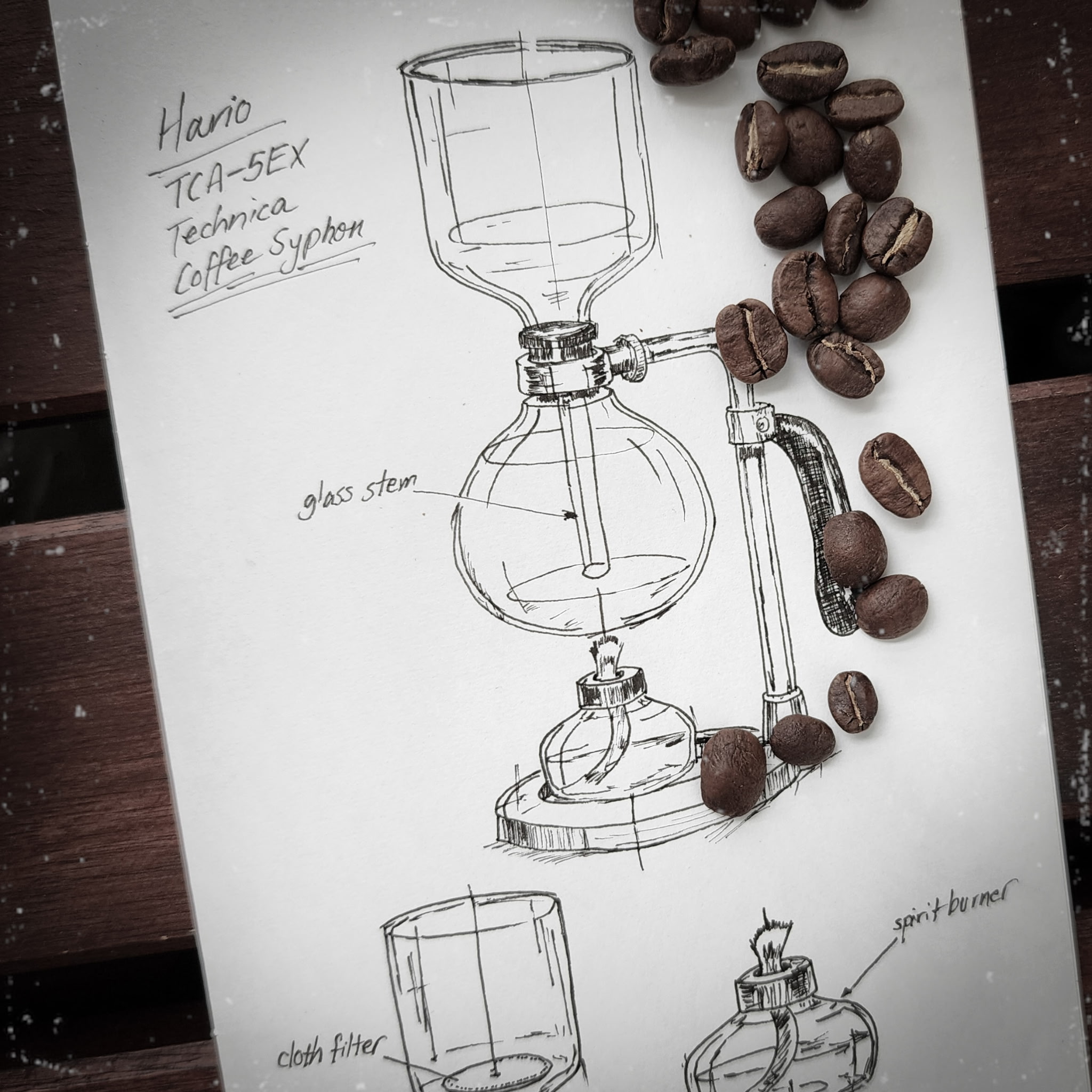
For several days the Hario TCA-5EX had occupied its place in my kitchen with the peculiar dignity of an instrument whose purpose seemed considerably more important than the preparation of a morning beverage. With its two glass chambers, cloth filter, dangling chain, bamboo paddle, and small alcohol burner, it appeared less a coffee maker than some modest piece of laboratory apparatus—the sort of contrivance with which a Victorian gentleman might attempt to isolate an unknown element and instead remove his eyebrows.
There are, of course, easier ways to make coffee.
This is precisely why I like the siphon.
A kettle and a common brewer would accomplish the task with admirable efficiency, but efficiency has become terribly overrated. There is something to be said for ceremony, particularly when the ceremony ends with a cup of coffee.
For this first experiment I chose 49th Parallel Epic Espresso, a light espresso roast bearing the promising description clean, floral, sweet. I weighed 32 grams of coffee and 500 grams of water, and set the Zwilling grinder to 24.
The number twenty-four deserves mention because I had already spent an unreasonable amount of time attempting to understand another number: sixty.
More specifically, the V60.
I had encountered repeated references to a V60 grind and naturally assumed this represented some established measurement of coffee grounds. This seemed reasonable enough until I began wondering why such a measurement should be called V60 rather than G60, at which point the entire matter started to acquire the unpleasant character of a riddle designed specifically to irritate me.
The explanation proved considerably less mysterious.
The V60 is a coffee brewer.
The V refers to its conical shape and the 60 to the angle of that cone.
There was no secret system of measurement. No obscure coffee arithmetic. No scale known only to baristas and men who own excessively small kettles.
It was a funnel.
A very good funnel, perhaps, but a funnel all the same.
With that minor embarrassment safely behind me, I turned my attention to the siphon.
I poured the water into the lower globe and lit the burner beneath it. Presently the water began to heat, and then came the part of the process that had attracted me to this ridiculous machine in the first place.
The water climbed.
Driven upward through the narrow glass tube, it passed from the lower globe into the chamber above until nearly the whole quantity of it had apparently escaped gravity. There is something wonderfully theatrical about this. One understands, in principle, that pressure is responsible, yet understanding the mechanism does very little to diminish the pleasure of watching it happen.
Glass, flame, water and pressure conducted their little demonstration of natural philosophy upon my table while I stood over them armed with a bamboo paddle.
Once the water had risen, I added the coffee.
The grounds scattered over the surface, floated briefly, then darkened as the water took them. I gave the mixture several gentle passes with the paddle—not a vigorous stirring, but sufficient persuasion to ensure that everything was properly acquainted.
Then I waited.
At thirty seconds I stirred once more.
At approximately one minute I removed the flame.
And then began the drawdown.
Or, more accurately, the waiting for the drawdown.
The coffee was expected to descend through the cloth filter and return to the lower globe in something approaching a minute.
Mine had other plans.
I watched.
It descended.
I continued watching.
It continued descending.
Two minutes.
There are few things capable of making two minutes seem quite so long as standing motionless beside a glass coffee apparatus while wondering whether one has done something terribly wrong.
Eventually there came the little gurgle signalling that the affair was complete. The coffee had returned to the lower chamber, the spent grounds remained above, and nothing had exploded.
For a first attempt, I considered this encouraging.
I poured the coffee and tasted it black.
It was very good.
This surprised me somewhat. I had prepared myself for the possibility that the first cup would be dreadful and that I would be obliged to drink it anyway out of principle.
Instead, the cup possessed only a slight bitterness—nothing offensive, but enough to make itself known.
I allowed it to cool.
Here the coffee performed another, quieter transformation. As the temperature fell, the bitterness diminished and an acidity that had previously hidden behind the heat became increasingly apparent. What had seemed a little bitter when hot became noticeably sour when cool.
The coffee itself had not changed in any meaningful sense. My perception of it had.
I found this rather fascinating.
We speak casually of what a coffee tastes like, as though the matter might be settled with a single sip. Yet this cup seemed unwilling to possess one fixed character. Heat concealed certain qualities and exaggerated others. As it cooled, flavours stepped forward that had previously remained somewhere behind the curtain.
A cup of coffee, it appears, has a small life of its own.
There remained, however, one difficulty.
I do not ordinarily drink my coffee black.
I take it with a little cream and sugar.
There is a peculiar temptation when acquiring some specialised instrument to begin behaving according to the imagined expectations of people who already know how to use it. One purchases a siphon and suddenly feels that coffee ought to be consumed black, accompanied perhaps by solemn pronouncements concerning jasmine, stone fruit, bergamot, and the precise altitude at which some distant Ethiopian farmer's goat happened to be standing.
I see no particular virtue in this.
I am not preparing coffee for an examination.
I am preparing it because I wish to drink it.
So I added cream and sugar.
Immediately the sharper edges softened. The bitterness retreated, as did much of the sourness, and the cup became smoother and altogether more agreeable.
Unfortunately, another problem presented itself.
It was slightly weak.
Not disastrously so. I did not pour it down the sink or curse the entire science of coffee. It was a perfectly pleasant cup.
But the cream had subdued the coffee more than I wanted.
This observation changed the nature of the experiment. My first instinct upon seeing a two-minute drawdown had been to grind considerably coarser. Such a change might indeed accelerate the descent and perhaps reduce some of the bitterness, but it might also produce a more delicate cup—and delicacy is of limited use if the addition of cream causes the coffee itself to disappear.
Thus the first experiment has provided something far more useful than perfection.
It has provided a point of departure.
Brew No. 1
Coffee: 32 g
Water: 500 g
Grind: Zwilling setting 24
Upper-chamber brew: 60 seconds
Drawdown: 2 minutes
Black, while hot: Very good, though slightly bitter.
Black, after cooling: Less bitter, but noticeably more sour.
With cream and sugar: Smooth and pleasant, though a touch too weak.
The second experiment shall therefore involve a modest alteration.
I will increase the coffee to 34 grams, while moving the grinder slightly coarser to 26. The brewing time shall remain at sixty seconds and the water at five hundred grams.
Brew No. 2
Coffee: 34 g
Water: 500 g
Grind: Zwilling setting 26
Upper-chamber brew: 60 seconds
The intention is simple enough: encourage a somewhat quicker drawdown without producing a cup so delicate that my cream overwhelms it.
Whether this will work remains to be seen.
There is something deeply satisfying in recording these numbers beside impressions that stubbornly refuse to become numbers themselves.
Thirty-four grams may be measured exactly. Five hundred grams of water may be weighed. Sixty seconds may be counted. The descent of the coffee through the filter may be timed to the second.
But slightly bitter cannot be weighed.
Nor can a little sour.
Nor almost, but not quite, strong enough.
These belong to another system of measurement entirely, one for which there are no instruments beyond the tongue, the nose, memory, and preference.
Perhaps this is what I am beginning to enjoy most about the siphon.
It occupies some narrow territory between experiment and ritual. It permits me to weigh, time, observe and record with all the seriousness of a laboratory assistant, while reminding me at the end that the most important part of the experiment cannot be measured at all.
After the glass and flame, the ratios and temperatures, the grinding and stirring and waiting, there remains only one instrument capable of delivering the final verdict.
I lift the cup.
I take a drink.
And I decide whether I should like another.